Article Summary
- Gov. JB Pritzker is seeking a rare third term, which he said will focus on completing many initiatives he has already started.
- Pritzker’s national profile has grown significantly and many are speculating he will announce a presidential campaign next year. He downplayed an upcoming trip to South Carolina.
- The governor says he deserves support from voters because of the progress he has made on the state’s financial health.
- With the race a rematch of 2022, Pritzker has largely focused his message on President Donald Trump rather than his opponent Darren Bailey, regularly launching attacks about Bailey’s ties to Trump.
This summary was written by the reporters and editors who worked on this story.
CHICAGO — When the retrospective analyses of his tenure in office are written, Gov. JB Pritzker says he hopes his legacy will rest on the same argument he’s making to Illinois voters in seeking a rare third term.
“I would like people to remember what I walked into when I took office, the challenges the state was facing, the structural deficit, the credit downgrades — 24 credit downgrades over the course of 15 years — and I turned all of that around,” Pritzker told Capitol News Illinois in an interview at his Loop campaign office in early October.
“You know, other people have talked about a turnaround,” Pritzker said, a not-so-veiled play on the largely unfulfilled “Turnaround Agenda” of his predecessor, one-term Republican Gov. Bruce Rauner. “We actually accomplished it over the last seven-and-a-half years.”
Much of Pritzker’s vision for a third term revolves around continuing what he has started, such as the mundane but crucial work of balancing the state’s annual operating budget while chipping away at the structural deficit.
“We’ve made a lot of progress, but we are only halfway to home, so to speak,” Pritzker said.
His challenger is once again Republican Darren Bailey, who lost by 12 points 4 years ago. He’s criticized the governor for overseeing massive budget growth from $38.5 billion in fiscal year 2019 to this year’s $55.9 billion spending plan.
But Pritzker says he needs another term because “there has to be consistency to it” and “a kind of repetition” in order to repair the reputational harm decades of fiscal mismanagement. He likes to site as proof the fact that Illinois has received 12 credit upgrades from the three major rating agencies since he took office.
He also wants to see universal preschool through to full implementation, which he thinks the state can accomplish in 2027 or 2028. Tackling the growing intersection of data centers, artificial intelligence and utility bills is also on his agenda.
“There’s so many things that we need to do in the state of Illinois,” Pritzker said. “It’s really one of the big reasons why I’m running for a third term, because all the progress we’ve made, so much more to do.”
Pritzker is already in rare territory. He’s just the fourth Democrat to win two terms in modern state history and is set to be the first to complete both. The other three were impeached, resigned or died in office. If he wins, he will be the first governor since Republican Jim Thompson to win a third term. Thompson would go on to win a fourth, serving from 1977 until 1991.
Legislative issues
His third term agenda could start before it would officially begin. Lawmakers return to Springfield for a veto session in mid-November, at which point they could consider regulating data centers. Pritzker has also become increasingly vocal about the need for more guardrails on artificial intelligence. He said Congress should lead on that issue, but he’s also set the table for more state involvement after he signed an executive order last month to create an AI cabinet.
Rising utility prices are also a concern for voters, but the state has a goal of eliminating carbon emissions from utilities by 2045. A report last month by the Illinois Environmental Protection Agency said the state will only reduce emissions by 53% from 2005 levels by 2050, far short of its carbon-free goals.
Nonetheless, Pritzker said the state has taken a “pretty good leap forward,” and he plans to focus on attracting more nuclear power to the state.
Teacher unions are also seeking more funding for public schools. Though they argue the Evidence-Based Funding model for K-12 schools struggles to keep up with schools’ needs at its current pace of $350 million new dollars annually, Pritzker said lawmakers can consider increasing funding without reforming the EBF law.
One way some advocates suggest increasing funding for education is by establishing a higher tax on millionaires. That would require voters to approve a graduated income tax amendment to the constitution, which they rejected in 2020 despite Pritzker using his own millions to boost the effort. Pritzker said he still supports the concept, but he’s leaving it up to lawmakers to come up with the proposal.
Helping him execute this agenda would be Christian Mitchell, a former state representative from Chicago who was a deputy governor under Pritzker in his first term.
Growing profile
But for all the third term plans, there’s an inescapable subtext underlying the campaign: Many national pundits view Pritzker as being on the shortlist for the 2028 Democratic presidential nomination.
Pritzker, for what it’s worth, has eschewed questions about whether he’ll seek to trade the Illinois Governor’s Mansion for the White House. But critics, and some allies, are convinced he will launch a presidential campaign in the early months of a third term.
“I truly believe he’s running for president on Nov. 4,” Bailey said in a September interview with Capitol News Illinois.
At the very least, he’s making moves to position himself as a national campaign presence. Embracing the mantle of “Team Fight,” Pritzker’s been one of President Donald Trump’s most pugnacious critics. He’s now a regular on the cable news, Sunday morning talk shows and influencer platforms, while also becoming a frequent guest speaker at state and local Democratic Party functions.
Pritzker will head to South Carolina on Saturday to address the state’s NAACP chapter. The Palmetto State will host the first Democratic presidential primary in January 2028. Gaining support from the state’s Black voters was key to former President Joe Biden’s 2020 campaign, as he won 61% of the nonwhite vote in the state’s primary in 2020, according to the Associated Press. The momentum carried his campaign to the party’s nomination.
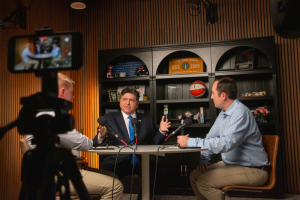
Gov. JB Pritzker, middle, discusses speaks in an interview with Capitol News Illinois reporters at his Chicago campaign office on Oct. 1, 2026. (Capitol News Illinois photo by Maggie Dougherty)
Pritzker brushed off the trip as nothing more than routine travel to help elect Democrats, but he noted he appears popular at the events he attends.
“Every one of the ones that I’ve attended, they’ve actually seen record results, record numbers of people, record amounts of money they’ve raised,” Pritzker said. “I hope I had something to do with that, and so I’m trying to help wherever I can.”
The governor, with a net worth estimated at $4.2 billion, according to Forbes, has opened his wallet for Democratic candidates and causes around the country. Pritzker’s allies recently launched Ready for the Fight PAC with $20 million in seed money from the governor. The PAC is targeting Republicans in House districts Trump won in 2024. And in 2022, Pritzker founded and donated millions to Think Big America, a dark money nonprofit group advocating for abortion rights in states where the issue was on the ballot.
The governor has also taken other notable steps. He walks four miles along Chicago’s lakefront nearly every morning. And he recently disclosed a Type 2 diabetes diagnosis, for which he was prescribed a GLP-1. The combination of diet, exercise and medicine has helped him lose more than 80 pounds since spring 2024.
Pritzker said he’s sharing his story because he thought it could help encourage others and that it had nothing to do with any future ambitions. And he defended withholding his diabetes diagnosis from Illinois voters for more than two years.
“I think the standard should be that if there’s something life-threatening or something that would interfere with my ability to do the job, I think that should be disclosed,” Pritzker said. “And I haven’t had any of those to disclose.”
His opponent
On the campaign trail, Pritzker talks first and foremost about Trump, often invoking the deeply unpopular Republican president’s name several times before acknowledging the Republican actually running against him, Darren Bailey.
Pritzker beat Bailey by more than a half-million votes to win reelection in 2022. After winning the primary earlier this year, Bailey apologized for calling Chicago a “hellhole” during that campaign and went on a charm offensive by engaging voters in the region.
Bailey has also promised not to legislate his well-established personal anti-abortion beliefs. But Pritzker doesn’t buy it and says voters shouldn’t either, especially after Bailey, as he did in 2022, earned Trump’s endorsement last month.
“It’s like he’s literally trying to ignore all the things that we knew about him as a result of the run that he had in 2022 and pretend that he’s somebody different — like he isn’t somebody who’s been a sycophant, a bootlicker for Donald Trump,” Pritzker said.
Pritzker’s campaign has also focused attacks on curriculum at Full Armor Christian Academy, a private Clay County school Bailey founded with his wife. Pritzker’s published attacks contending that a biblical text used in the school teaches that dinosaurs and humans coexisted, though scientific evidence says they went extinct about 65 million years before humans.
“I’m OK with people’s religious beliefs and how it is that they want to live their lives around those beliefs,” Pritzker said. “What I’m not OK with is pushing it on kids where you’re teaching them something that has truly been proven untrue.”
The governor said he’s campaigning on his own set of deeply held beliefs — that people should have access to abortion.
State of the race
Nearly all the major political handicappers rate the Illinois governor’s race as “solid Democratic.” A Public Policy Poll conducted Sept. 30 and Oct. 1 for Chicago News Weekly lent credence to that, finding Pritzker with a commanding 20-point lead over Bailey.
As he has in his previous campaigns, Pritzker’s dominated in spending. The billionaire self-funder has poured $90.5 million into his campaign war chest this cycle, a slower clip than the $171 million he spent in 2018 and the $145 million in 2018.
Bailey, meanwhile, reported $405,000 in donations of $1,000 or more between July 1 and September 30, according to the State Board of Elections, after beginning July with $127,990 on hand. Unlike 2022, when Lake Forest billionaire Richard Uihlein gave Bailey $12 million and an outside anti-Pritzker PAC $42 million, Pritzker’s 2026 spending has gone uncontested.
It’s both a reflection of an Illinois Republican Party that hasn’t won a statewide race in more than a decade and the ascendance of Pritzker as the dominant figure in the state’s Democratic Party, which has benefited from millions in Pritzker donations.
The governor’s growing influence is seen in the state’s officeholders. He helped install state Rep. Lisa Hernandez, D-Cicero, as Democratic Party of Illinois chair in 2022 and boosted allies Lt. Gov. Juliana Stratton and state Rep. Margaret Croke, D-Chicago, earlier this year in open Democratic primaries for U.S. Senate and comptroller, respectively.
And if Secretary of State Alexi Giannoulias is elected mayor of Chicago in 2027, Pritzker would have the opportunity to appoint his replacement in the plum political office.
The governor has also donated hundreds-to-millions of dollars to bankroll the state’s Democratic Party, support Democratic statewide officials and to help the leaders of the House and Senate Democratic caucuses fund races for their targeted members.
Pritzker views his party building as essential to his governing, contending that he’s accomplished much of his agenda in the first two terms in part because he campaigned for and funded fellow Democrats across the state.
“I think you’ve seen each time that I was on the ballot, whether it was in 2018 or 2022, that we’ve increased the number of Democrats in the House and the Senate, and I’m hopeful that we’ll be there this time as well,” Pritzker said.
Capitol News Illinois is a nonprofit, nonpartisan news service that distributes state government coverage to hundreds of news outlets statewide. It is funded primarily by the Illinois Press Foundation and the Robert R. McCormick Foundation.