Article Summary
- Gov. JB Pritzker won a historic third term as Illinois governor, becoming the first Democrat to do so.
- The race was once again called immediately as polls closed at 7 p.m., and Democrats appeared to be outperforming even the 2022 election that cemented their grip on state government.
- It was accompanied by a national “blue wave” election that saw Democratic gains across the country.
This summary was written by the reporters and editors who worked on this story.
CHICAGO — Democratic Gov. JB Pritzker was elected to a rare third term as Illinois governor Tuesday, vanquishing Republican Darren Bailey in a race that was once again called immediately when polls closed as Democrats rode a historic wave of momentum in races throughout the country.
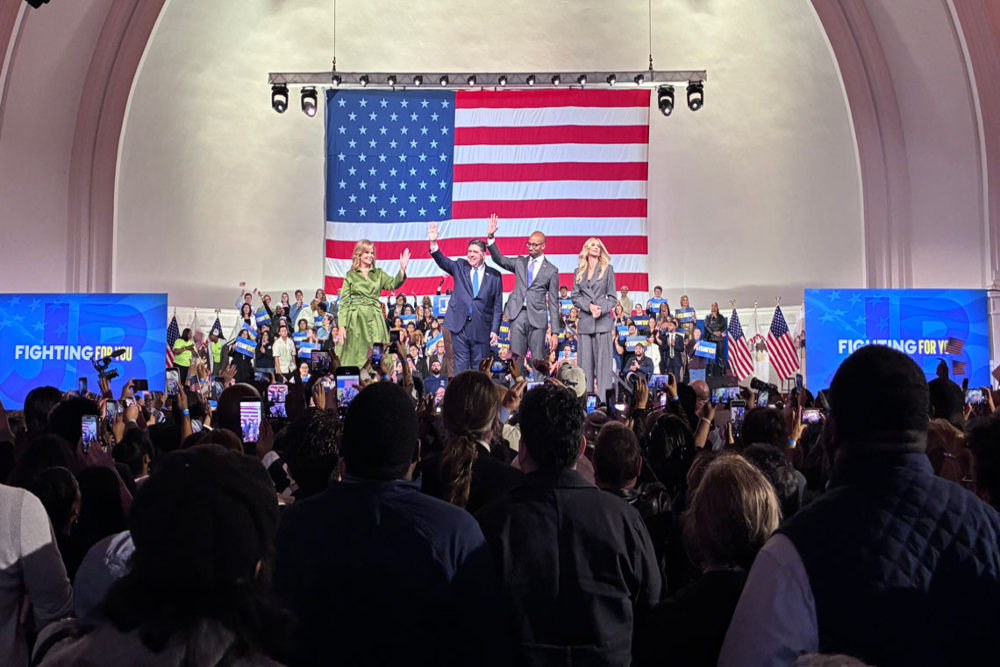
“The early results across the country are resuscitating a strange feeling inside of me: hope,” Pritzker, who invested more than $40 million in races outside Illinois, said in his victory speech, delivered in a Navy Pier ballroom shortly after polls closed. “Because it looks like maybe, just maybe, something is stirring in the conscience of America.”
The Associated Press called the race as soon as polls closed. With 61% of votes counted, Pritzker had a roughly 60% to 37% lead over Bailey, a margin of more than 500,000 votes out of about 2.7 million counted as of 9:30 p.m. Independent Collin Corbett was in third place with about 3%, though exact margins were subject to change.
Pritzker finished the 15-minute address with his signature “Are you ready for the fight?” rallying cry. But the governor, one of President Donald Trump’s most pugnacious critics, delivered an unapologetic love letter to Illinois, attempting to convey a message of hope over fear — though it included hints at his national ambitions.
“In the world right now, politicians fall into one of two camps: Those that ask you to hope, and those that want you to fear,” Pritzker said. “For eight years, I’ve asked you to join me in hope. And I’d like to take a measure tonight of what hope, and hard work, has gotten us.”
Pritzker then recited a litany of legislative accomplishments from the first two terms, such as raising the minimum wage, passing balanced budgets and expanding abortion rights.
“And if all of that wasn’t good enough for you – well, hope has also given us a winning White Sox season, and a Bears playoff win over the Packers and a Chicago Pope,” Pritzker said.
But if he started with a love letter to state he’s led for nearly eight years, his ending struck a decidedly national tone, alluding to the question that shadowed him throughout the 2026 campaign: Will he seek his party’s nomination for president in 2028?
“There is one question I have gotten a lot in the last few months – what’s next?” Pritzker said. “The answer is simple. I’m going to ask you to continue to hope – and to wrap your hope, in courage. We climbed one mountain tonight. But we are sitting at the base of another.”
The mood was less cheery in Effingham, where Bailey addressed the crowd at 9:30 p.m. Bailey’s running mate Aaron Del Mar initially told reporters just before 9 p.m. that pair wouldn’t concede until votes are counted.
“I have no regrets,” an emotional Bailey said. “We hit, we fought, we worked hard, you were by our side – there are no regrets.”
The outcome was not a surprise given Illinois’ Democratic lean and a favorable national climate for the party. And Bailey couldn’t compete with Pritzker’s vast financial resources, allowing the Democrat to control the narrative and denying the Republican the ability to respond in a meaningful way.
Start of 2028 campaign?
While Pritzker ran on a long list of accomplishments during his second term, he made clear throughout the campaign there’s still work to do. He repeated the point Tuesday.
In between shaking hands and slapping backs at Manny’s Deli in the South Loop, a traditional Election Day stop for Illinois politicos, Pritzker told reporters he was already thinking ahead to the fall veto session, when he hopes to pass legislation to keep the Bears in Illinois and regulate data centers. And the governor told Capitol News Illinois in October that he would like to continue stacking balanced budgets and credit rating upgrades and see universal preschool through to full implementation.
But Pritzker said little about his third term plans in his speech. Instead, he quickly took aim at the man he’s quarreled with for the last two years: President Donald Trump.
“Fear greed. Fear cruelty. Fear corruption. Fear intolerance and callousness and unchecked power,” Pritzker said. “Fear politics devoid of empathy. Fear any leader who does not appreciate a life filled with simple joys.”
With an American flag as a backdrop, Pritzker outlined national challenges such as healthcare, campaign finance reform and the explosive growth of artificial intelligence companies he believes should be challenged.
Pritzker first started fielding questions about interest in the presidency after his 2022 victory speech contained national undertones.
He’s downplayed interest in the White House for years, but now the clock is ticking toward a decision as the year winds down. Barack Obama announced his presidential campaign in Springfield in 2007 just four months after the midterm election. Though Pritzker dismissed the notion that the 2028 primary has effectively begun.
“I don’t know who that begins for,” Pritzker said earlier in the day. “I can tell you that tomorrow, I’m gonna be continuing the work of being governor.”
Pritzker professed his love for the state, and his current job, during his speech Tuesday evening. He also praised Illinoisians for protesting Trump.
“I love that the people here never once fell into the trap of succumbing to the wiles of a petty tyrant, but instead, we recommitted ourselves to the noble precept that democracy and freedom go hand-in-hand,” Pritzker said.
Illinois’ governor has raised his national profile significantly during his second term, in part as Trump put the state in his crosshairs. Despite being on the ballot himself, he traveled the country extensively on behalf of Democratic candidates across the country.
Pritzker’s travel to early primary states like South Carolina, New Mexico and Nevada raised speculation that on top of the governor’s stated purpose of supporting Democrats on the ballot in 2026, he was laying the groundwork and building relationships ahead of 2028.
Pritzker also donated at least $40 million to Democratic candidates and causes in his personal capacity and through Ready for the Fight PAC, which is run by his political team.
Those donations have prioritized Democrats running in Republican states and districts, especially candidates of color running in southern states where district lines were redrawn following the Supreme Court’s ruling weakening protections against racial gerrymandering. Several of them were on track to win.
History in Illinois
Pritzker, who will become the longest-serving Democratic governor in Illinois history upon completion of his second term, is the first of his party to win a third term. And he’s the first governor of either party to accomplish the feat since Republican Jim Thompson in 1982.
His more than 60% vote share is on pace to exceed his first two elections and be the highest for a Democratic governor since Adlai Stevenson II in 1948.
Pritzker led Cook County — home to more than 40% of the state’s population — 77.3%-19.8% as of 8:45 p.m. and led in the suburban collar counties, according to unofficial returns.
Pritzker was on pace as of Tuesday evening to be the first Democrat to carry McHenry County in a governor’s race since 1852, if the results hold. He also held a lead in Sangamon County, which hasn’t gone blue since 1964.
Despite campaigning with a new approach that promised “more listening and less talking” in the state’s northeastern corner, Bailey trailed in every suburban county that had reported results as of 9:30 p.m.
The Republican nominee was leading most counties outside the Chicago region, though Pritzker led in major downstate population centers, including McLean, Peoria, and St. Clair counties.
Pritzker, a self-funding billionaire, poured more than $90 million into his campaign account this election cycle. This helped fuel a relentless paid advertising campaign that promoted his governing record while highlighting Bailey’s ties to Trump and socially conservative positions on issues like abortion and guns.
The most cutting Pritzker attack ads focused on the curriculum of a private school Bailey founded with his wife, which contended that a biblical text used in the school teaches that dinosaurs and humans coexisted, though scientific evidence says they went extinct about 65 million years before humans.
In an interview with WGN that was later amplified by Pritzker messaging, Bailey wouldn’t say whether he believed it himself, rhetorically asking, “Were you there?”
It was a moment that highlighted the challenges for Bailey’s second run.
But Bailey also blamed Pritzker for a threat the school received by email, which the Illinois State Police have been unable to trace, according to Bailey’s campaign.
The Xenia farmer started the general election campaign with an olive branch to the Chicago region, temporarily moving into an apartment in the South Loop, appearing at Bulls and White Sox games and even apologizing for calling the state’s most populous city a “hellhole” in 2022.
He promised to be laser-focused on affordability, education and public safety. And he said he would not legislate his personal anti-abortion position.
But many Illinois voters only saw the version of Bailey that Pritzker wanted them to see, with the governor’s campaign outspending his challenger at least 25-to-1.
Bailey did not have enough campaign cash to get on television — a necessity to communicate with voters on a mass scale in a state of nearly 13 million.
And Republican megadonor Richard Uihlein, who gave Bailey $12 million directly and $40 million to an anti-Pritzker PAC in 2022, gave just $6,900 this cycle.
Peyton Cook contributed to this story from Effingham.
Capitol News Illinois is a nonprofit, nonpartisan news service that distributes state government coverage to hundreds of news outlets statewide. It is funded primarily by the Illinois Press Foundation and the Robert R. McCormick Foundation.