- President Donald Trump has been the dominant political force within the Republican Party for more than a decade, but he was barely mentioned by party leaders at Republican Day at the Illinois State Fair on Thursday.
- Instead, the GOP candidates were laser focused on Gov. JB Pritzker and Democrats who hold all statewide offices and supermajorities in the General Assembly.
- Illinois Republican Party Chairman Bob Grogan said he sees an opening to win over new voters due to Democratic policies he cast as extreme. Or, to put it another way: “It’s common sense versus communism,” he said.
This summary was written by the reporters and editors who worked on this story.
SPRINGFIELD (Capitol News Illinois) — President Donald Trump has been the dominant political force within the Republican Party for more than a decade.
But as Illinois GOP faithful gathered Thursday in Springfield for their annual day at the Illinois State Fair, their party’s national leader was barely mentioned. Instead, the GOP candidates were laser-focused on Gov. JB Pritzker and Democrats who hold all statewide offices and supermajorities in the General Assembly.
“Everywhere we go, we hear the same thing: Illinois is too damn expensive, and it’s time to change it,” said Darren Bailey, the Republican gubernatorial nominee. “Property taxes, they’re crushing homeowners. Electric bills are exploding. Groceries, insurance, gas, childcare — they all cost more. Everything costs more under JB Pritzker. After nearly eight years in office, the excuses are over.”
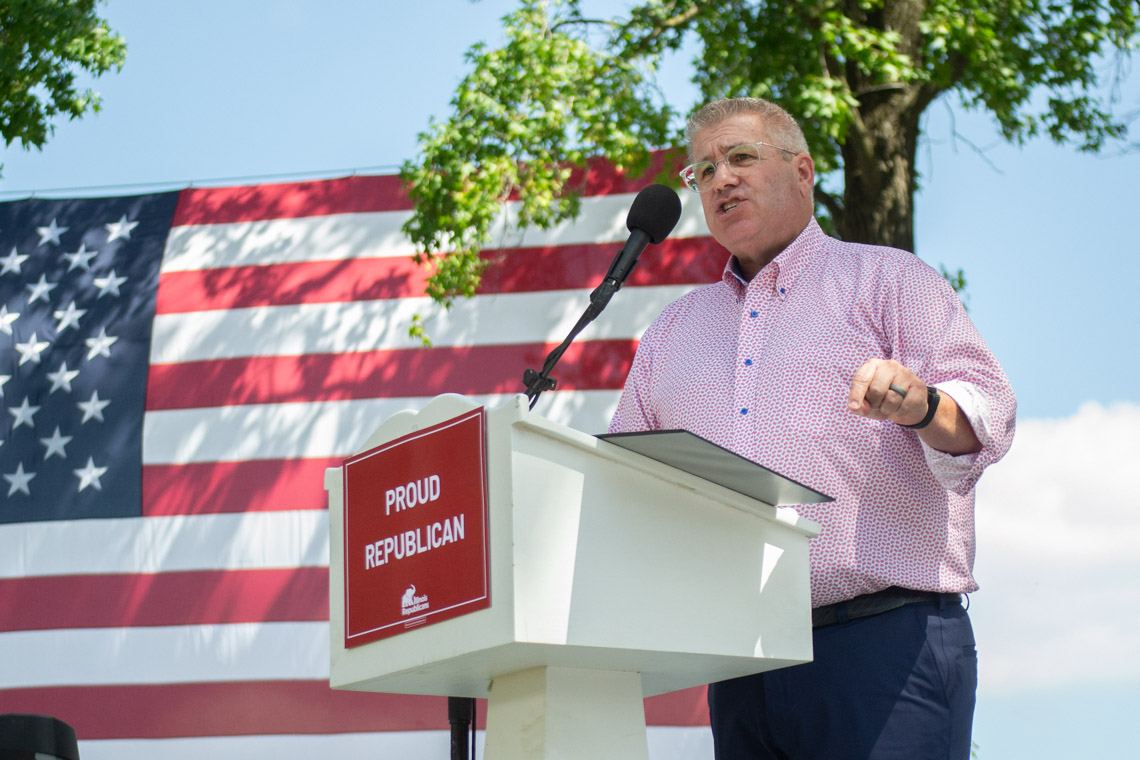
It was a stark contrast to Democrats Day at the fairgrounds on Wednesday, where Pritzker and other statewide elected officials focused their ire on Trump while barely mentioning their underdog Republican opponents.
On Republican Day, Trump’s name was conspicuously absent, with GOP leaders blaming the state’s Democrats for soaring energy costs, high property taxes and other affordability concerns on voters’ minds. Unlike the previous day, there was no mention of the impact of Trump’s tariff regime and the war with Iran on the price of consumer goods and gasoline.
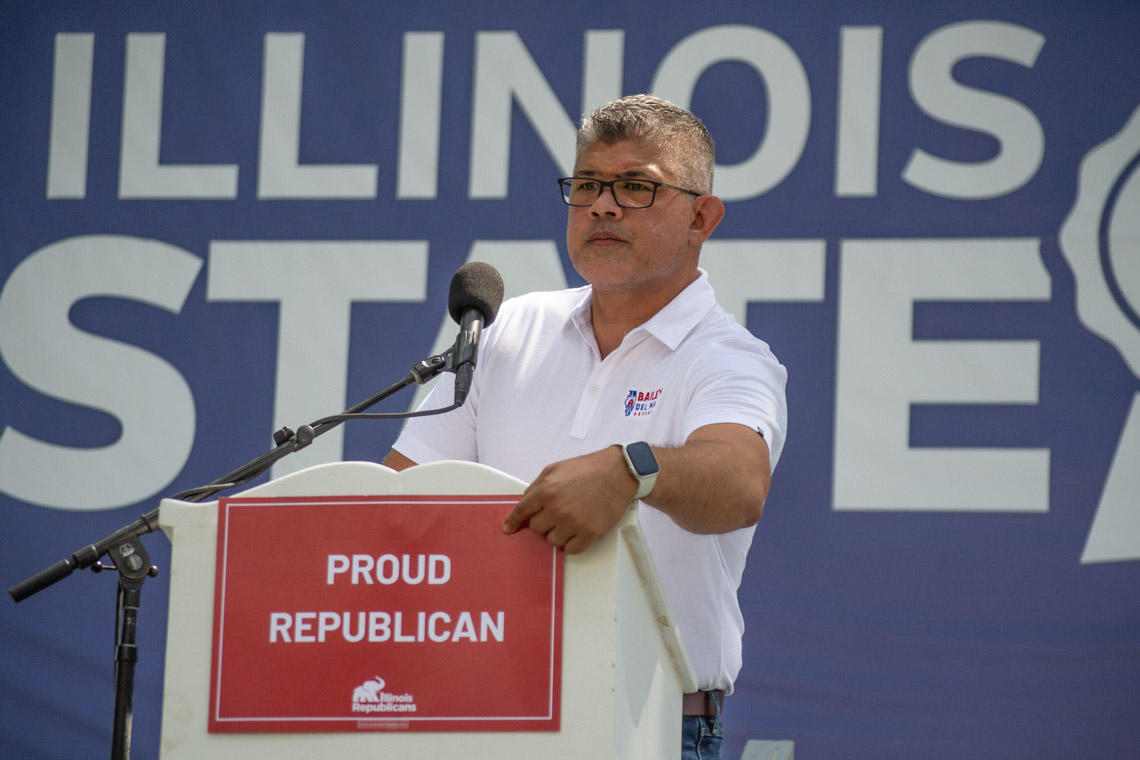
“We need to stop looking at Washington and start looking at Springfield,” said Aaron Del Mar, Bailey’s running mate.
‘Common sense vs. Communism’
Illinois Republicans are in their worst electoral position in a generation. They’re locked out of all statewide offices, relegated to superminority status in the General Assembly and hold just three of 17 congressional seats.
Trump registered his best electoral performance in Illinois in 2024, but the closer margin didn’t come because he received substantially more votes. Instead, many Democratic voters apparently stayed home rather than casting a ballot for Kamala Harris.
The president’s unpopularity has proven an anchor to Republicans running down ballot, particularly in the Chicago suburbs. Compounding that is the collapse of the party’s fundraising base, which was heavily dependent upon a handful of wealthy donors like former Gov. Bruce Rauner and venture capitalist Ken Griffin.
The former stopped funding the Illinois GOP after a landslide election loss to Pritzker in 2018 and the latter bolted Illinois for Florida after his favored candidate in the 2022 GOP gubernatorial primary came in third place to Bailey.
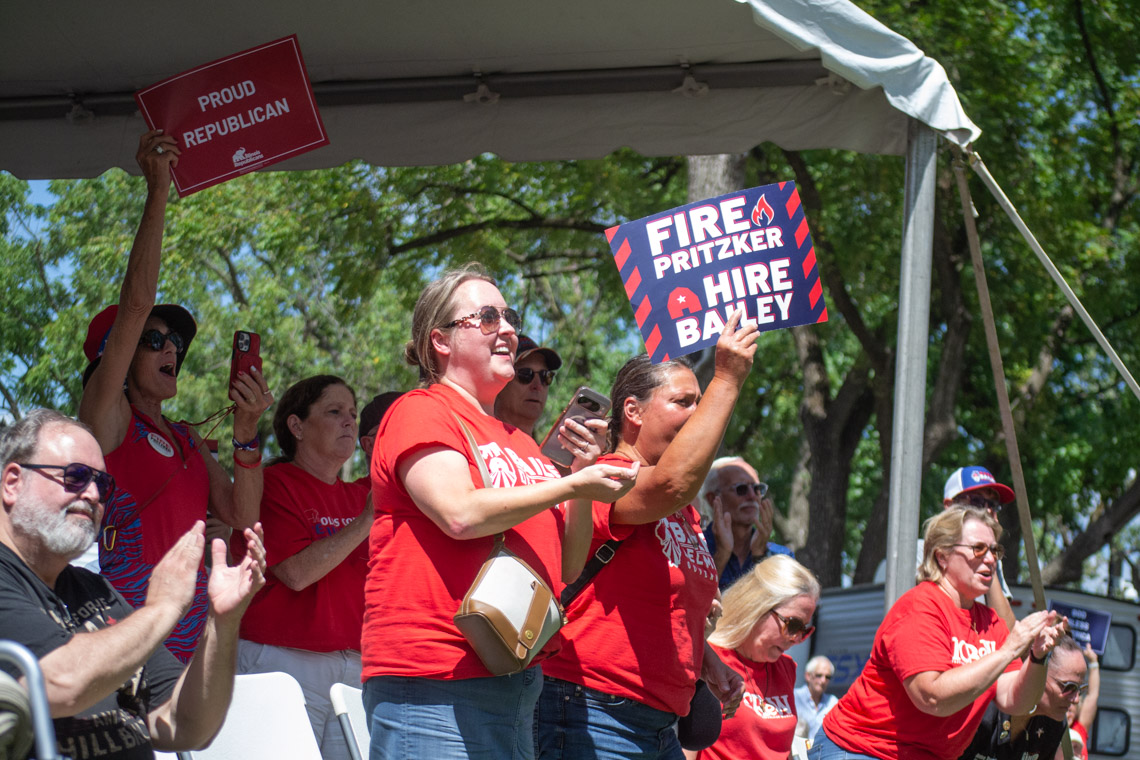
Over the past decade, the party has cycled through four different chairmen, each tasked with building back a fundraising apparatus and desperately trying to encourage supporters skeptical of vote-by-mail to bank their votes. They’ve also had to mend intraparty feuds.
Illinois Republican Party Chairman Bob Grogan, who defeated incumbent Kathy Salvi for the statewide party post earlier this year, joked to reporters that he “probably has the second-hardest job in the world” after Trump.
“Look, it was never going to be an easy year,” Grogan said of 2026. “It’s Illinois. We always have an uphill fight. But I’ll say this: If you actually think that the polls are the end-all, be-all, talk to President Hillary Clinton.”
While Trump’s shock victory in 2016 defied polling, Illinois Republicans haven’t had a similar night in more than a decade. The last statewide races the party won were in 2014, when Rauner defeated incumbent Democratic Gov. Pat Quinn and Comptroller Judy Baar Topinka was reelected. They haven’t won a federal race since Mark Kirk’s 2010 victory over Democrat Alexi Giannoulias for U.S. Senate.
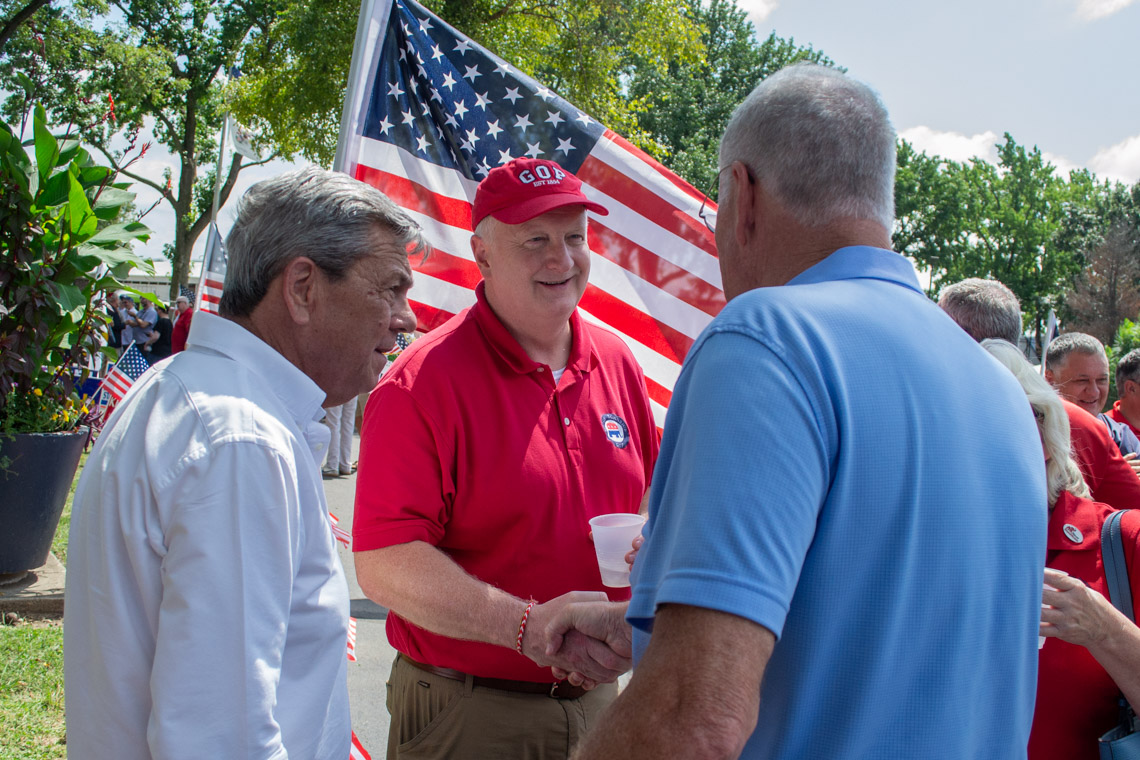
But Grogan said he sees an opening to win over new voters due to Democratic policies he cast as extreme. Or, to put it another way: “It’s common sense versus communism,” he said.
“We won the Cold War, but we lost the war in the universities, where communism was kept in a petri dish just to be regrown here in some of the youth,” Grogan said.
Voter fatigue with Pritzker, who’s seeking a third term, will win out over Trump’s continued unpopularity in Illinois, Grogan said.
“We’ve had some long-term trends that we’re trying to reverse,” Grogan said. “Donald Trump’s not on the ballot. I got asked if Speaker Welch is the next Mike Madigan. Here’s the thing: As the Republican Party, we were a one-trick pony. We just ripped on Mike Madigan. Deserved, but that was our campaign strategy. You know what? The Democrats, they’re a one-trick pony. All they do is rip on Donald Trump. He’s not on the ballot either.”
Focusing on Illinois
Bailey openly embraced Trump when he was running for governor in 2022. He accepted the president’s endorsement at a rally just outside of Quincy days before the primary election. At that rally, the farmer-turned-politician from southern Illinois promised to “roll the red carpet out for him because Illinois will be ready for President Trump.”
But Pritzker smoked Bailey that fall and, two years later, Trump lost the state by an 11-percentage-point margin to Harris. In his rematch with Pritzker, Bailey is singing a different tune. He made no mention of Trump in his prepared remarks and sought to avoid politically tough subjects like abortion rights.
“I am committed to staying focused on what unites us instead of divides us,” Bailey said. “We know that’s affordability, that’s safety, and that’s education. I will not be legislating nor restricting abortion. I’ve made that statement before, and I will stick with that.”
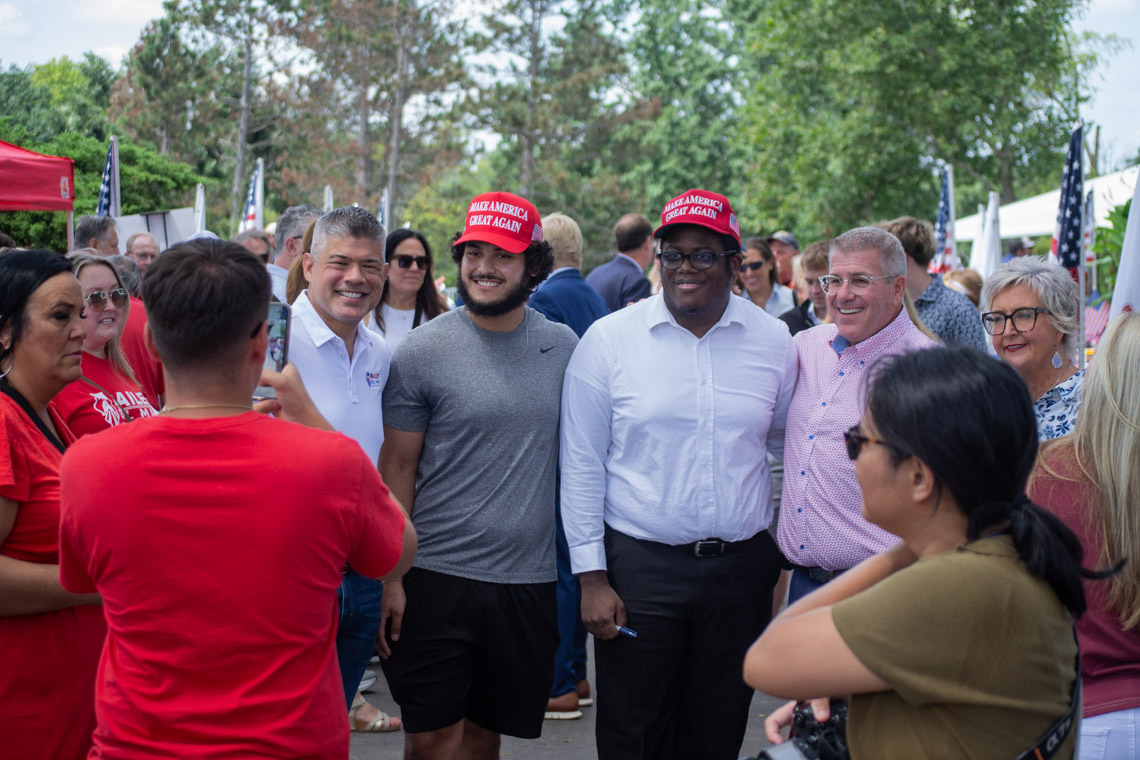
Bailey said Trump “has nothing to do with the problems that Illinois is having right now” while pledging to work with whoever is president.
“They’ve been winning elections,” Bailey said of Democrats. “I think this election cycle is going to be different because people are waking up because Illinois is too expensive, and there’s only one party and one person that that gets pointed back to, and that is JB Pritzker and the Democrat leadership in Springfield.”
Other Republican candidates echoed Bailey.
“Donald Trump didn’t raise the budget by 40% here in the state of Illinois, and I guess my question to the people of this state would be: Is your life 40% better? And it’s not,” said Bryan Drew, the GOP nominee for comptroller, referring to the not-adjusted-for-inflation climb in state spending under Pritzker.
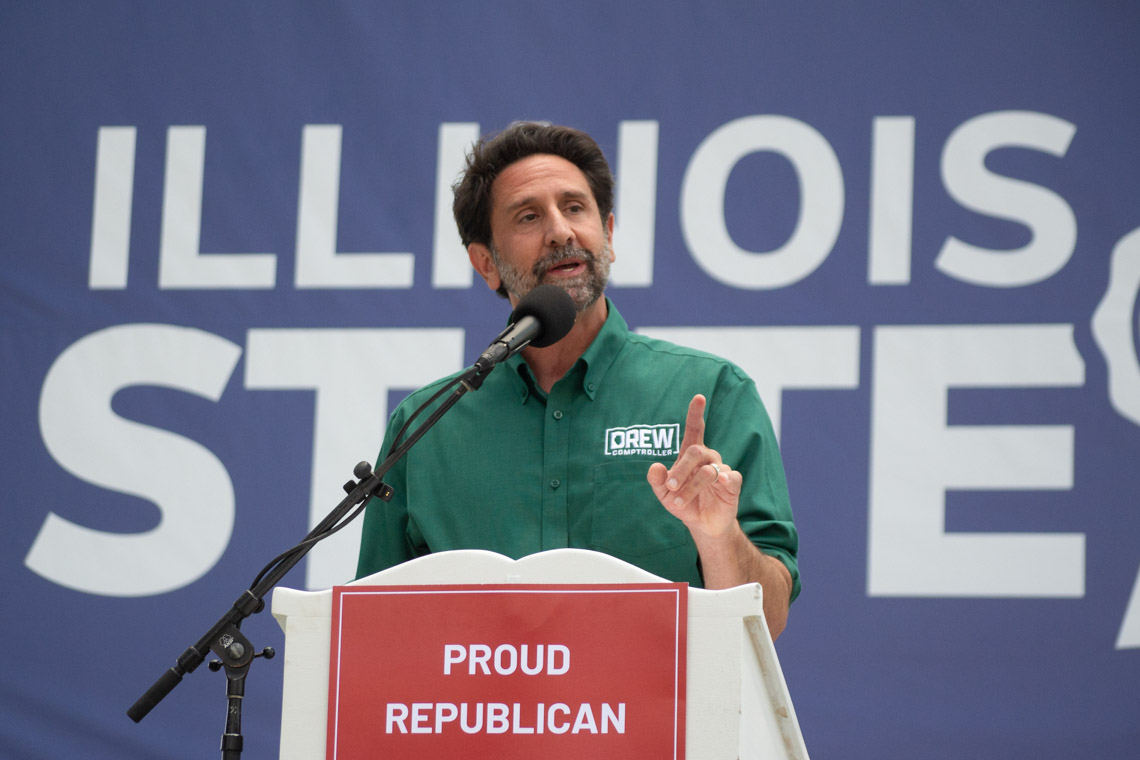
While not openly embracing Trump, Republicans did not walk away from him.
Don Tracy, the party’s nominee for U.S. Senate, told reporters that he “would certainly welcome the endorsement of the president of the United States.” He also said he would have supported former Trump personal attorney and now-Attorney General Todd Blanche’s nomination.
Rhonda Belford, the Illinois national GOP comitteewoman, told party officials that she recently had a meeting at the White House that included a private audience with Trump in the Oval Office.
“When he found out who I was, he said, ‘Oh, you got to get rid of JB Pritzker,'” Belford recalled. “I said, ‘We’re trying.’”
The $65 million elephant
But to dislodge Pritzker, Republicans will have to overcome a vast financial disadvantage. The governor, a billionaire self-funder, last week cut a $65 million check to his campaign fund, which will support his bid for a third term and help Democrats up and down the ticket. Bailey, on the other hand, has just a few hundred thousand in his account.
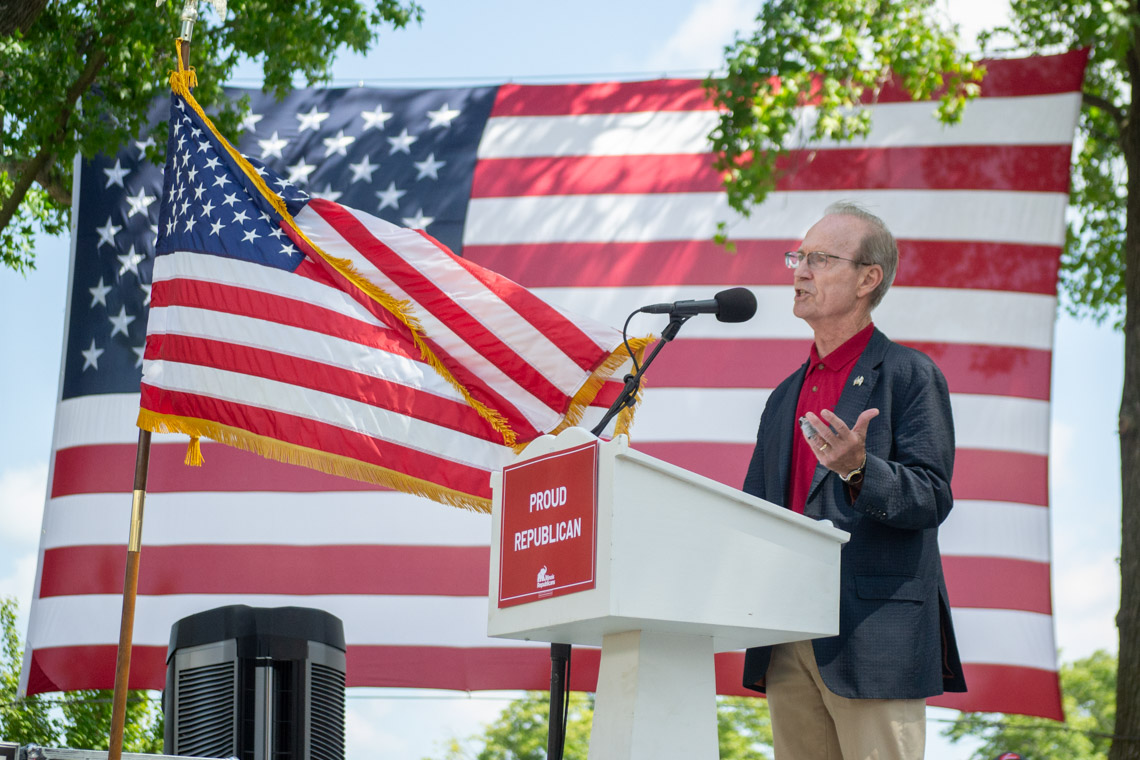
Republicans running for statewide office, the General Assembly and Congress also face similar fundraising disparities, which will impede their ability to purchase advertising and support campaign operations. And candidates in non-statewide races must grapple with gerrymandered legislative and congressional maps drawn to lock in Democratic power in Springfield and send a disproportionately Democratic delegation to Washington.
But party leaders said money and district leans aren’t the only decider of races, pointing to the defense of state House and Senate seats in 2024 against better-funded Democratic challengers.
“Democrats may have the money, they may have the map, but they don’t own the voters,” said House Minority Leader Tony McCombie, R-Savanna. “We may not be able to outspend them, especially with Sugar Daddy in office,” an apparent reference to the deep-pocketed Pritzker, “but we can outwork them.”
Del Mar said Pritzker’s spending is because “he knows a fight is coming to him.”
“If you think you’re going to win by 30 points, you don’t put $65 million in your account,” Del Mar said.
By Brenden Moore, Capitol News Illinois
Capitol News Illinois is a nonprofit, nonpartisan news service that distributes state government coverage to hundreds of news outlets statewide. It is funded primarily by the Illinois Press Foundation and the Robert R. McCormick Foundation.
This article first appeared on Capitol News Illinois and is republished here under a Creative Commons Attribution-NoDerivatives 4.0 International License.