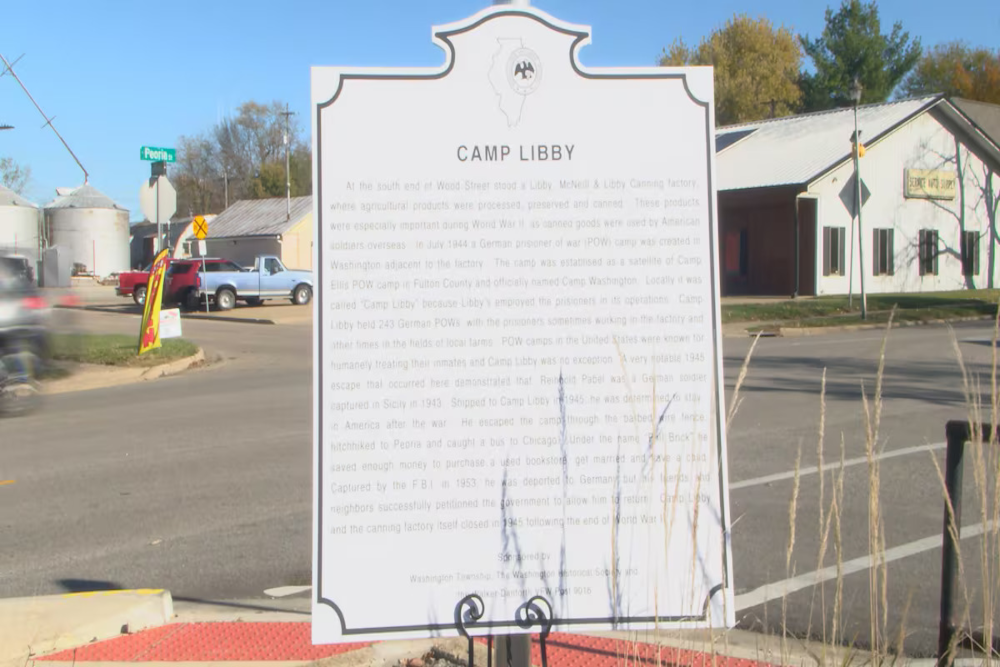
WASHINGTON (25News Now) – A piece of Washington’s World War II history is getting permanent recognition more than 80 years after hundreds of German prisoners of war were held in the community.
The Washington Historical Society and Walker-Danforth VFW Post 9016 dedicated a new Illinois State Historical Marker Tuesday morning honoring Camp Libby, a former German prisoner of war camp located near the intersection of U.S. Business 24 and South Wood Street.
Established in July 1944, Camp Libby, officially known as Camp Washington, housed 243 German prisoners of war captured during World War II. The facility operated as a satellite camp of Camp Ellis in Fulton County.
The prisoners worked at the nearby Libby, McNeill & Libby canning factory, where agricultural products were processed and preserved for American soldiers serving overseas. Prisoners also worked in farm fields throughout the surrounding region.
Joshua Roberts, a retired Army chief warrant officer and member of VFW Post 9016, said preserving the site’s history is important for remembering the sacrifices made during the war.
“Our country exists because of the sacrifices the men and women have done for us,” Roberts said. “And so there’s times that we get to the spot where we almost forget the sacrifices occurred, and we start just enjoying our freedoms without understanding where that cost came from.”
One of Camp Libby’s most unusual stories involves German prisoner Reinhold Pabel, who escaped from the camp in 1945.
According to the historical marker, Pabel was captured in Sicily in 1943 before eventually being transferred to Camp Libby. Determined to remain in the United States after the war, he escaped through the camp’s barbed-wire fence, hitchhiked to Peoria and boarded a bus to Chicago.
There, he assumed the name Phil Brick, eventually purchasing a used bookstore, getting married and having a child.
The FBI apprehended Pabel in 1953, and he was deported to Germany. However, his friends and neighbors successfully petitioned the federal government to allow him to return to the United States.
The camp and canning factory closed in 1945 following the end of World War II, according to the marker.
Tuesday’s dedication also came one day before Veterans Day, adding significance to the ceremony for Roberts and other veterans in attendance.
Roberts said he hopes the marker encourages younger generations to learn more about their community’s past.
“I hope they see it. And then they it causes them to kind of come up with, the imagination of what else was going on here,” Roberts said. “So they kind of use that as a stepping stone to understand more about World War Two and about the city of Washington and its historical past.”
The marker was sponsored by Washington Township, the Washington Historical Society and Walker-Danforth VFW Post 9016.